

source on Google
Short answer: for most places, a restaurant website 2027 customers actually use works alongside Zomato and Swiggy. Stay on the apps for new customers. Use your own website and WhatsApp ordering for regulars, so you keep more of each bill and own the customer’s number. Start simple: a fast menu page, a “Order on WhatsApp” or “Order direct” button, table booking, and your Google listing pointing to it.
Ask any restaurant owner about delivery apps and you’ll hear the same two things. The apps bring orders you’d never get otherwise. And the commission on every order eats into a margin that was thin to begin with. Your own online ordering can win back some of that, but only if customers actually use it. This guide explains when it’s worth it, what the site needs, and how to move regular customers from the apps to you without losing them.
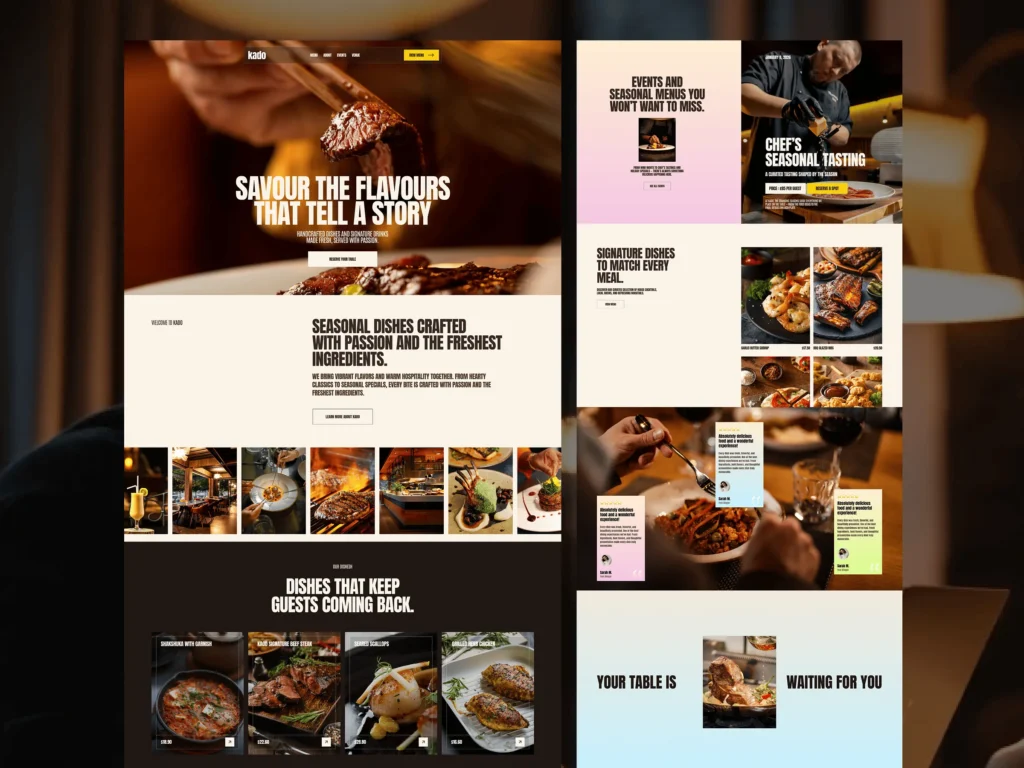
What Zomato and Swiggy give you, and what they cost
The apps are very good at one thing: putting your restaurant in front of hungry people who have never heard of you. They handle discovery, payments, delivery riders and customer support. For a new restaurant or cloud kitchen, that reach is hard to replace.
The cost comes in three forms. A commission on each order, plus charges for ads and visibility inside the app. Discounts you’re pushed to fund to stay visible. And the customer relationship: the app knows who ordered, how often and what they like, and you usually can’t contact them directly. You can read the current partner terms on the Zomato partner page and Swiggy’s partner site; check the numbers for your city before you plan.
When your own restaurant website 2027 ordering makes sense
Direct ordering is worth setting up when at least one of these is true:
- A good share of your orders come from the same customers every week.
- You deliver within a small area with your own riders, or customers often pick up.
- You run a cafe, bakery or cloud kitchen with a loyal local following.
- You take bulk orders, office lunches, party orders or catering, which apps handle badly.
- Your app commission bill each month is large enough that saving part of it pays for the website within a few months.
If almost all your orders are one-time customers from the apps, focus on dine-in and the apps first. A website can come a little later.
Three ways to take orders directly
WhatsApp ordering is the simplest. A menu page on your website with an “Order on WhatsApp” button opens a chat with the item list filled in. Your staff confirm, take payment by UPI link and arrange delivery or pickup. It costs almost nothing and many customers prefer it.
A proper ordering page with a cart and online payment suits busier places. Customers pick items, add notes, pay by UPI or card, and the order appears on a screen or tablet in the kitchen. Several ready-made ordering platforms for restaurants do this for a monthly fee, or it can be built into your website.
ONDC is a government-backed open network where restaurants can list through seller apps and appear in several buyer apps at once, usually at lower commission than the big platforms. It’s still growing, so treat it as an extra channel. Details are on the ONDC website.
What every restaurant website 2027 needs
- A menu as a web page, with prices, photos of your best dishes and veg or non-veg marks. Not a PDF, which is slow on phones and invisible to Google.
- Opening hours, kitchen closing time and delivery hours, matching your Google listing exactly.
- Address with a map, parking notes and a “Get directions” button.
- Call and WhatsApp buttons that stay visible on phones.
- Online ordering or an order-on-WhatsApp button.
- Table booking for dine-in, especially weekends; our answer on adding online booking covers the options.
- Real photos of the place, the food and the team.
- Your FSSAI licence number on the menu or ordering page. FSSAI expects food sold online to show it, and careful customers look for it. You can check licence details on the FSSAI FoSCoS portal.
Moving regular customers from the apps to your restaurant website 2027 ordering
You can’t message app customers directly, but you can reach them when they’re in front of you or holding your food. A few ways restaurants do it:
- A small card in every delivery bag with a QR code to your ordering page and a reason to use it, such as a free dessert on the first direct order.
- Table tents and bills with the same QR code for dine-in guests.
- A WhatsApp number on the packaging for bulk and party orders.
- Slightly better value direct: a combo or a loyalty stamp that isn’t on the apps.
Check each app’s partner rules before adding inserts, since some restrict what can go in their bags.
Payments for restaurant website 2027 orders
UPI is the easiest for most customers, with cards for those who prefer them, and cash on delivery for regulars you know. A payment gateway gives every order a proper record and makes refunds simple. Our answer on whether UPI is enough explains the mix.
Google Maps decides a lot of walk-ins
“Restaurants near me” and “cafe in Sector 29” searches happen all day. Your Google Business Profile should have the right category, accurate hours, your menu link, your ordering link, plenty of recent food photos and replies to reviews. Our Google Business Profile checklist 2027 walks through it, and our answer on getting more Google reviews covers the part most restaurants struggle with.
On the website, add restaurant structured data with your cuisine, address, hours and menu link, so Google reads your details correctly. Google’s local business structured data guide covers the Restaurant type.
Restaurant website 2027 mistakes to avoid
- A menu only as a PDF or as photos of the printed menu.
- Different prices on the website, the apps and the printed menu, with no explanation.
- Hours on Google that are months out of date.
- A heavy homepage video that takes ten seconds to load on mobile data.
- Direct ordering that nobody watches, so orders sit unconfirmed during a busy service.
- No reason for customers to order direct, so they keep using the app out of habit.
What a restaurant website 2027 looks like for different places
A cafe needs a menu with photos, timings, a map and a reason to visit: events, live music nights, a laptop-friendly corner. Table booking for weekends and WhatsApp ordering for takeaway cover most of what regulars want.
A cloud kitchen has no dining room, so the website is the brand. Each brand needs its own menu page, a direct ordering flow and a strong reason to order direct, such as a combo or loyalty offer the apps don’t have.
A fine dining restaurant sells the experience. Real photos of the room and the food, the chef’s story, set menus, a private dining or events page and a smooth reservation form count for more here than delivery.
A sweet shop or bakery gets a lot of festival, birthday and bulk orders. A restaurant website 2027 setup for them should make pre-orders easy, with a delivery date picker, cake customisation notes and advance payment by UPI. Diwali and wedding season orders alone can pay for the site.
A restaurant with several outlets needs one page per outlet, each with its own address, hours, phone and Google Business Profile, and a shared menu where prices are the same.
Is a restaurant website 2027 worth it for a small place?
For a single small outlet, a one-page site with the menu, timings, map, WhatsApp ordering and table booking does most of the work, and it’s quick to set up. For a cafe chain, a cloud kitchen brand or a place with heavy catering and bulk orders, a full ordering system pays off sooner because the volume is there. Either way, the website has to be fast on a phone and easy for your staff to update when prices change.
What it costs
A starter restaurant website with menu, timings, map and WhatsApp ordering fits our starter package, from ₹15,000 (about $180). A site with a cart, online payments and a kitchen order screen is priced on a written scope; custom software with us starts from ₹50,000. See all starting prices on our pricing page.
A simple plan for 2027
- Keep Zomato and Swiggy for reach.
- Launch a fast restaurant website 2027 page set: menu, timings, map, table booking and WhatsApp ordering.
- Fix your Google Business Profile and start collecting reviews.
- Put a QR code to direct ordering on every bag, bill and table.
- After three months, compare direct orders with app orders and decide whether a full ordering system is worth it.
Frequently asked questions
Should I leave Zomato and Swiggy if I have my own website?
Usually not. The apps bring new customers your website can’t reach on its own. Use your website to move regular customers to direct orders, and keep the apps for discovery.
Can customers order on WhatsApp from my website?
Yes. A menu page with an “Order on WhatsApp” button is the simplest direct ordering, and many customers prefer it. Your staff confirm and send a UPI link.
Do I need to show my FSSAI licence on my restaurant website 2027 menu?
If you sell food online, show your FSSAI licence number on the menu or ordering page. It’s expected for food sold online, and it builds trust.
Should my menu be a PDF?
No. Put the menu on a web page with prices and photos. PDFs load slowly on phones and Google can’t read them as well.
Is ONDC worth trying?
It can be, as an extra channel with lower commission. It’s still growing, so keep your main apps and test ONDC alongside them.
Get a plan for your restaurant website
Tell us about your restaurant, your delivery area and how you take orders today. Within 24 hours you’ll get a written scope, a fixed price and a timeline for your restaurant website 2027 setup, free of charge. Get a free proposal, or see our website development services.