

source on Google
Summary
This is the most complete WordPress vs Shopify 2026 guide available for business owners, startups, and e-commerce brands. We compare both platforms across pricing, SEO, design, security, speed, and long-term growth. You will find two detailed comparison tables, real cost breakdowns in USD, GBP, and INR, and a clear verdict for every type of business. Whether you are launching your first online store or rebuilding an existing one, this guide will help you make the right decision. CrestVox Studio builds on both platforms and has worked with clients across the UK, US, Australia, Canada, and India.
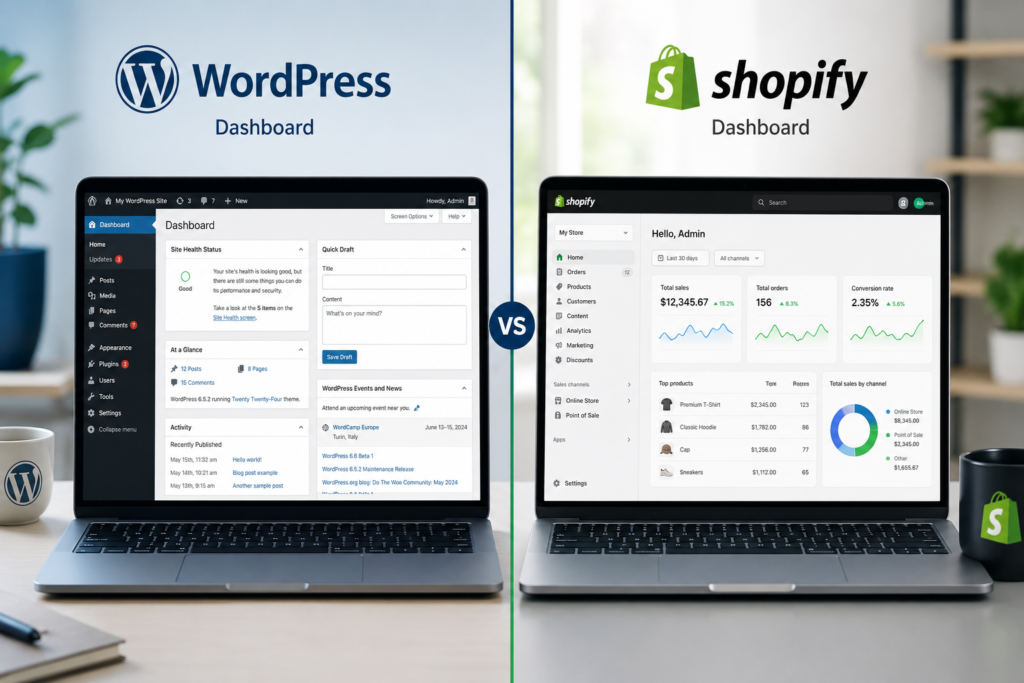
The WordPress vs Shopify 2026 debate is more relevant than ever. With AI tools reshaping how stores are built and marketed, choosing the wrong platform in 2026 can cost you months of rebuilding and thousands in wasted spend. Both platforms have matured significantly, but they serve very different types of businesses.
This guide does not pick sides. It gives you the real picture from an agency that builds on both platforms every week. By the end, you will know exactly which platform suits your business, your budget, and your growth plan.
What Is WordPress and What Is Shopify?
Before comparing WordPress vs Shopify 2026, it helps to understand what each platform actually is at its core.
WordPress is an open-source content management system that powers over 43% of all websites on the internet as of 2026. It is free to install but requires hosting, a domain, and plugins to function. For e-commerce, you add WooCommerce, which is also free but requires additional plugins, themes, and developer work to build a fully functional store.
Shopify is a fully hosted Software as a Service e-commerce platform. Everything, including hosting, checkout, SSL, and core store infrastructure, is built in. You pay a monthly subscription, and your store is ready to launch. As of 2026, Shopify powers over 10% of global e-commerce stores and dominates among fast-growing direct-to-consumer brands.
This fundamental difference shapes every other comparison in the WordPress vs Shopify 2026 debate. One gives you maximum control but asks you to manage everything. The other gives you convenience but within a controlled environment.
Before comparing WordPress vs Shopify 2026, it helps to understand what each platform actually is at its core.
WordPress is an open-source CMS (Content Management System) that powers over 43% of all websites on the internet as of 2026. It is free to install but requires hosting, a domain, and plugins to function. For e-commerce, you add WooCommerce, which is also free but requires additional plugins, themes, and developer work to build a fully functional store. Unlike a website builder, WordPress gives you complete ownership of your code and data.
Shopify is a fully hosted e-commerce platform and Software as a Service solution. Everything, including hosting, checkout, SSL, and core store infrastructure, is built in. You pay a monthly subscription, and your store is ready to launch. As of 2026, Shopify powers over 10% of global e-commerce stores and dominates among fast-growing direct-to-consumer brands and D2C businesses.
This fundamental difference shapes every other comparison in the WordPress vs Shopify 2026 debate. One gives you maximum control but asks you to manage everything. The other gives you convenience but within a controlled environment. Neither is a pure website builder, both are serious platforms for building a long-term online presence.
WordPress vs Shopify 2026: Quick Comparison Table
| Feature | WordPress + WooCommerce | Shopify |
|---|---|---|
| Ease of Use | Medium to Advanced | Beginner Friendly |
| Hosting | You manage it | Fully included |
| Pricing | Variable, can be low or high | Fixed monthly plans |
| SEO Control | Very deep control | Strong basics, less URL control |
| Customisation | Unlimited with code | High but platform limited |
| Security | You manage it | Mostly managed for you |
| Support | Community or paid experts | 24/7 platform support |
| E-commerce Features | Flexible with plugins | Built in, store-first |
| Transaction Fees | None from WooCommerce | 0.5% to 2% if not using Shopify Payments |
| Content Marketing | Exceptional | Basic to moderate |
| Speed Out of Box | Depends on hosting | Generally fast |
| Best For | Content-led, custom, SEO-focused | Fast launch, scaling stores |
WordPress vs Shopify 2026: Pricing Breakdown
Pricing is one of the most misunderstood parts of the WordPress vs Shopify 2026 comparison. The sticker price is never the full story.
WordPress + WooCommerce Real Cost
WordPress itself is free. But running a proper WooCommerce store in 2026 involves multiple costs that add up quickly:
- Hosting: $10 to $80 per month, depending on quality
- Domain name: $10 to $20 per year
- Premium theme: $50 to $200 one-time
- Essential plugins: $100 to $500 per year
- Security plugin: $50 to $200 per year
- Backup solution: $50 to $150 per year
- Developer setup: $500 to $3,000 one-time
Realistic total first-year cost: $800 to $5,000 USD, depending on how custom your store needs to be.
For UK businesses that have decided on WordPress, our WordPress development agency UK page covers the full process from design to launch.
Shopify Real Cost
Shopify is easier to predict but can get expensive as you scale:
- Basic plan: $29 per month (USD)
- Shopify plan: $79 per month
- Advanced plan: $299 per month
- Premium theme: $150 to $350 one-time
- Apps: $50 to $500 per month as you grow
- Transaction fees: 0.5% to 2% if not using Shopify Payments
Realistic total first-year cost: $600 to $4,000 USD for a standard store with a few apps.
When comparing total cost of ownership over 3 years, WordPress often becomes more cost-effective for content-heavy businesses that invest in quality hosting upfront. Shopify becomes more cost-effective for high-volume stores using Shopify Payments where transaction fees are waived. Always calculate your total cost of ownership over 2 to 3 years, not just the first month, before making your platform decision.
Full Cost Comparison Table: WordPress vs Shopify 2026
| Cost Item | WordPress + WooCommerce | Shopify |
|---|---|---|
| Platform cost | Free | $29 to $299 per month |
| Hosting | $10 to $80 per month | Included |
| Domain | $10 to $20 per year | $14 to $20 per year |
| Theme | $0 to $200 one-time | $0 to $350 one-time |
| Plugins or Apps | $100 to $500 per year | $50 to $500 per month |
| Transaction fees | None | 0.5% to 2% (third-party) |
| Developer setup | $500 to $3,000 | $300 to $1,500 |
| Security tools | $50 to $200 per year | Included |
| Year 1 total estimate | $800 to $5,000 | $600 to $4,000 |
In the WordPress vs Shopify 2026 debate, the platform with the lower entry price is not always the cheaper option once you add hosting, plugins, apps, and developer time.
Ease of Use: WordPress vs Shopify 2026
This is where WordPress vs Shopify 2026 has the clearest difference for non-technical business owners.
Shopify is built for merchants, not developers. You sign up, pick a theme, add products, set up payments, and launch. Most business owners can set up a basic Shopify store in a weekend without any developer help. The dashboard is clean, the settings are logical, and daily store management is simple.
WordPress has a steeper learning curve. Installing WordPress, setting up WooCommerce, choosing plugins, configuring settings, and managing hosting are all separate tasks. For non-technical users, this often means hiring a developer for the initial setup and ongoing maintenance. Once the site is built, managing content is straightforward, but the backend requires more technical awareness.
If you want to launch fast with minimal technical involvement, Shopify wins this round of the WordPress vs Shopify 2026 comparison clearly.

SEO: WordPress vs Shopify 2026
SEO is where the WordPress vs Shopify 2026 comparison gets interesting for businesses that rely on organic search traffic.
WordPress SEO Strengths
WordPress gives you complete control over every SEO element. You can customise URL structures, add custom schema markup, build complex internal linking structures, create content hubs, and optimise every page independently. With plugins like RankMath or Yoast SEO, the technical SEO setup is comprehensive and flexible.
For content-heavy websites, blogs, and businesses that rely on ranking for hundreds of keywords, WordPress is the stronger choice in the WordPress vs Shopify 2026 debate. The platform was built as a CMS first, and its content architecture reflects that.
Shopify SEO Strengths
Shopify handles the basics of SEO very well out of the box. Title tags, meta descriptions, canonical tags, XML sitemaps, and structured data are all built in. For product pages and collection pages, Shopify performs consistently well on Google.
The limitation is URL structure. Shopify forces certain URL patterns for products and collections that cannot be fully customised. This is a minor issue for most stores but can matter for large catalogues with complex category structures.
According to Google’s Core Web Vitals data, Shopify stores pass Core Web Vitals at a rate of 52% to 58% on average, while WordPress stores average 38% to 42% unless properly optimised. This means Shopify often has a performance edge without extra work, which helps SEO rankings in 2026.
For businesses investing in ecommerce website development with a strong content strategy, WordPress consistently outperforms Shopify in long-tail keyword rankings. The open-source CMS architecture allows for deeper site structure customisation that search engines reward over time.
SEO Verdict
For e-commerce SEO focused on product pages, Shopify is easier. For content-led SEO, long-form blogs, and deep keyword strategies: WordPress wins. In the WordPress vs Shopify 2026 SEO comparison, your content strategy determines the winner.
E-commerce Features: WordPress vs Shopify 2026
Shopify E-commerce Features
Shopify was built for selling. Out of the box, you get inventory management, discount codes, abandoned cart recovery, multichannel selling, Shopify Payments, shipping integrations, and detailed sales analytics. The Shopify App Store has thousands of apps for every functionality you need.
For dropshipping, Shopify is the market leader with seamless integrations for DSers, Zendrop, and other suppliers. If your business model involves dropshipping, Shopify makes setup significantly faster than WooCommerce.
WooCommerce E-commerce Features
WooCommerce is highly flexible. You can build custom product types, create complex pricing rules, integrate any payment gateway without transaction fees, and customise the checkout flow completely. For businesses with unusual product logic, subscription models, or membership sites, WooCommerce often provides more freedom than Shopify.
WooCommerce does not charge platform transaction fees, which saves money at scale compared to Shopify’s third-party payment fees.
Design and Customisation: WordPress vs Shopify 2026
Both platforms offer strong design options in 2026, but with different levels of freedom.
Shopify has a polished theme ecosystem. Most Shopify themes are mobile-first, conversion-optimised, and easy to customise through the theme editor. For deep structural changes, Shopify uses Liquid templating which requires developer knowledge. The platform has some design constraints that WordPress does not.
WordPress gives you near-total design freedom. You control the theme code, the CSS, the layout, and every visual element. With a custom-built WordPress theme, your website can look and function exactly how you want with no platform constraints. This is why agencies like CrestVox Studio prefer WordPress for highly custom projects where brand uniqueness is critical.
Security: WordPress vs Shopify 2026
Security is a practical consideration that many business owners overlook in the WordPress vs Shopify 2026 decision.
Shopify manages SSL certificates, PCI compliance, hosting security, and platform updates for you. For most business owners, this is a significant relief as they do not need to think about server security.
WordPress security depends entirely on your setup. Your hosting provider, the plugins you use, how often you update, and whether you have a security plugin running all determine how secure your site is. A well-maintained WordPress site is very secure, but it requires ongoing attention. According to Patchstack’s 2026 security research, outdated plugins remain the number one cause of WordPress vulnerabilities.
If security management is not something you want to handle, Shopify is the safer default in the WordPress vs Shopify 2026 security comparison.
WordPress vs Shopify vs Webflow 2026: Quick Comparison
Many business owners searching for the right platform in 2026 also consider Webflow alongside WordPress vs Shopify. Here is how all three compare at a glance.
Webflow is a visual website builder with a built-in CMS and basic e-commerce functionality. It sits between WordPress and Shopify in terms of complexity. Webflow gives designers more visual control than Shopify but less e-commerce depth. For serious online stores, Webflow is not the strongest choice, its e-commerce features are limited compared to WooCommerce or Shopify. Where Webflow excels is for design-heavy marketing websites and landing pages that do not need a large product catalogue.
| Feature | WordPress | Shopify | Webflow |
|---|---|---|---|
| Best for | Content, SEO, custom stores | Fast-scaling e-commerce | Design-heavy marketing sites |
| E-commerce strength | Very strong (WooCommerce) | Best in class | Basic to moderate |
| SEO control | Deepest control | Strong basics | Good basics |
| Ease of use | Medium to advanced | Easy | Medium |
| Pricing | Variable | $29 to $299 per month | $23 to $212 per month |
| Hosting | You choose | Included | Included |
| Customisation | Unlimited | High with limits | High visually |
| Large catalogues | Excellent | Excellent | Limited |
For most businesses choosing between WordPress vs Shopify vs Webflow in 2026, the decision comes down to this: choose Webflow if design is your top priority and e-commerce is secondary. Choose Shopify if selling is your top priority. Choose WordPress if content, SEO, and long-term control matter most.
CrestVox Studio specialises in WordPress and Shopify development. If you are considering Webflow, we can advise on whether it is the right fit or whether WordPress would serve you better long-term. Contact us for a free platform consultation.
In the WordPress vs Shopify 2026 security comparison, Shopify wins on convenience while WordPress wins on control, but only if you actively maintain it.
Speed and Performance: WordPress vs Shopify 2026
Website speed directly affects both SEO rankings and conversion rates in 2026. In the WordPress vs Shopify 2026 performance comparison, the results depend heavily on your setup.
Shopify uses a global CDN and optimised infrastructure by default. Most Shopify stores load fast without any additional work from the store owner. This is one of Shopify’s biggest practical advantages for business owners who do not want to think about performance.
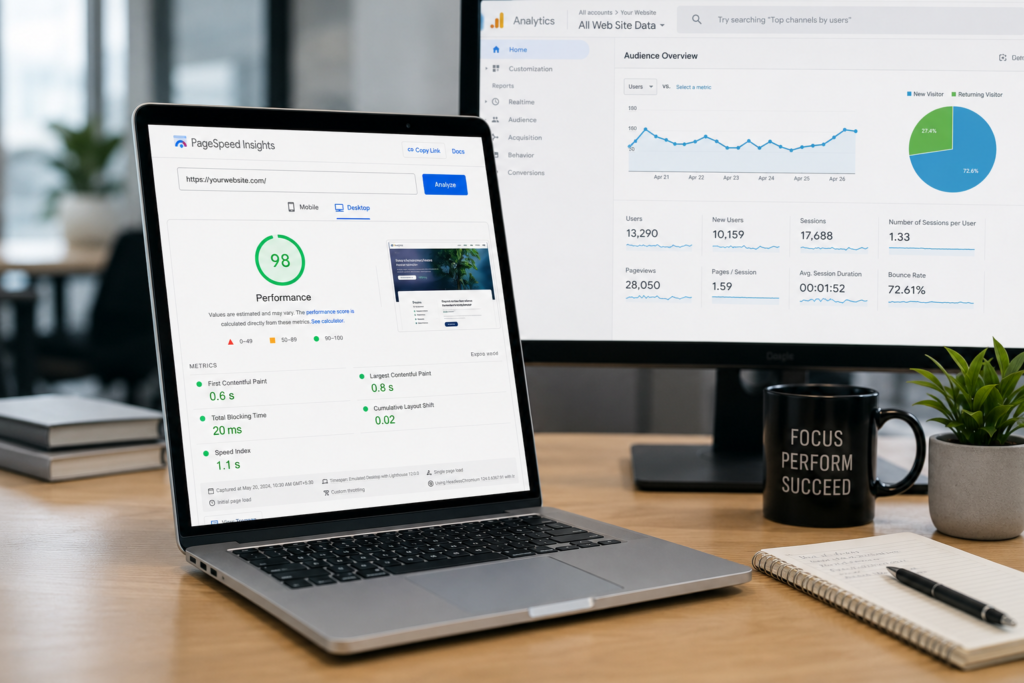
WordPress speed depends on your hosting, your theme, and your plugins. A poorly optimised WordPress site can load very slowly. However, a properly optimised WordPress site with good hosting, a lightweight theme, caching, and image optimisation can achieve Google PageSpeed scores of 90 or above, matching or beating most Shopify stores.
At CrestVox Studio, we regularly take WordPress sites from PageSpeed scores of 30 to 40 up to 90 or above through speed optimisation work. The potential is there, it just requires the right setup.
WordPress vs Shopify 2026: Which Is Right for Your Business?
Choose Shopify If:
- You want to launch your store fast with minimal technical setup
- You are doing dropshipping or selling physical products
- You do not want to manage hosting, security, or updates
- You want reliable 24/7 support from the platform
- You are scaling quickly and need a stable, predictable infrastructure
- Your primary focus is selling, not content marketing
- You are a D2C brand selling physical products directly to consumers
- You want a fully hosted e-commerce platform with zero server management
Choose WordPress If:
- You want complete control over your website design and code
- Your business relies heavily on content marketing and SEO
- You need complex custom product types or checkout flows
- You want to avoid monthly platform fees at scale
- You have developer support available or plan to hire it
- You are building a membership site, learning platform, or content-led store
WordPress vs Shopify 2026: India, UK, US, and Australia Perspective
The WordPress vs Shopify 2026 choice also depends on where your business operates and who your customers are.
In India, WooCommerce is significantly more popular among SMBs because of lower hosting costs, more affordable developer rates, and the flexibility to integrate Indian payment gateways like Razorpay and Paytm without extra fees. Shopify India pricing has improved, but transaction fees and app costs still add up for smaller businesses.
In the UK, the US, Australia, and Canada, Shopify dominates among e-commerce brands launching new stores. The predictable pricing, fast setup, and Shopify Payments integration make it the default choice for most direct-to-consumer brands in these markets. WordPress remains strong for content-led businesses, agencies, and established brands that need more control.
At CrestVox Studio, we help clients in all these markets choose and build on the right platform. You can contact our team for a free consultation, and we will recommend the right platform based on your specific business goals.
Can You Migrate Between WordPress and Shopify?
Yes, migration is possible in both directions, but it carries SEO risk. When you change platforms, product URLs, category paths, and blog slugs often change. Without a proper 301 redirect plan, you can lose significant organic traffic.
If you are considering migration, plan it carefully. Map every old URL to a new URL, set up 301 redirects before launch, and monitor your rankings closely in Google Search Console for the first 90 days after migration.
CrestVox Studio handles platform migrations for clients moving from Wix, Squarespace, or Shopify to WordPress, and vice versa. We ensure your SEO rankings are protected throughout the migration process.
Why CrestVox Studio Builds on Both Platforms
At CrestVox Studio, we do not recommend one platform over the other for every client. The right answer in the WordPress vs Shopify 2026 debate depends entirely on your business model, your team, and your goals.
We build custom WordPress websites and WooCommerce stores for clients who need SEO depth, content control, and full design freedom. We also build Shopify stores for clients who need fast launches, reliable infrastructure, and straightforward scaling.
- Custom code only, No page builders, no bloated templates on either platform
- SEO built in, Every project optimised for Google from day one
- Transparent pricing, Fixed project quotes with no hidden fees
- Fast delivery, Most projects are completed in 2 to 6 weeks
- Ongoing support, Maintenance and support after launch on both platforms
Not sure which platform is right for your business? Get in touch with CrestVox Studio for a free consultation. We will assess your goals and give you an honest recommendation with no sales pressure.
Frequently Asked Questions
Is WordPress better than Shopify in 2026?
Neither platform is universally better. WordPress is better for content-heavy websites, deep SEO strategies, custom product logic, and businesses that want full control over their code. Shopify is better for fast launches, simple store management, dropshipping, and businesses that do not want to manage hosting or security. The right choice depends on your business model and technical resources.
Which is cheaper, WordPress or Shopify in 2026?
WordPress can be cheaper to start but costs more if you need custom development, premium plugins, and managed hosting. Shopify has predictable monthly pricing but app costs and transaction fees add up as you scale. For small stores, WordPress often costs less over time. For fast-scaling stores using Shopify Payments, Shopify can be more cost-effective long-term.
Which platform is better for SEO, WordPress or Shopify?
WordPress gives you deeper SEO control including full URL customisation, advanced schema markup, complex content structures, and more flexible internal linking. Shopify handles core SEO basics well and often performs better on Core Web Vitals out of the box. For content-led SEO strategies, WordPress wins. For product-focused stores where technical SEO basics are enough, Shopify performs well.
Can I switch from Shopify to WordPress or WordPress to Shopify?
Yes, migration between platforms is possible but must be done carefully. URL structures change during migration which can hurt your SEO rankings. You need a proper 301 redirect map covering every product page, category page, and blog post. Monitor Google Search Console closely for 90 days after migration. Working with an experienced agency reduces the risk of losing organic traffic during the switch.
Is Shopify good for dropshipping in 2026?
Yes. Shopify remains the leading platform for dropshipping in 2026. Integrations with DSers, Zendrop, and AliExpress make product sourcing and order fulfilment straightforward. WooCommerce also supports dropshipping through plugins but requires more setup and technical management compared to Shopify’s plug-and-play approach.
Do I need a developer for WordPress or Shopify?
You can launch a basic Shopify store without a developer if your needs are simple. WordPress almost always requires developer help for initial setup, especially for WooCommerce stores. Once either platform is properly set up, day-to-day management can be handled without technical knowledge. For custom designs, speed optimisation, or advanced features, developer support is valuable on both platforms.
Which platform is better for Indian businesses in 2026?
For Indian businesses, WordPress with WooCommerce is often the more cost-effective choice. Lower hosting costs, affordable local developer rates, and free integration with Indian payment gateways like Razorpay and Paytm make WooCommerce popular among Indian SMBs. Shopify is a strong option for Indian businesses targeting international customers who want a globally recognised platform.
Does CrestVox Studio build both WordPress and Shopify stores?
Yes. CrestVox Studio builds custom WordPress websites, WooCommerce stores, and Shopify stores for clients in the UK, US, Australia, Canada, and India. We assess your business goals and recommend the right platform rather than pushing one over the other. Every project is built with custom code, SEO built in, and transparent fixed pricing. Contact us for a free consultation and platform recommendation.